
What is vegetative reproduction in African violets and popularity
What is vegetative reproduction in African violets and popularity
African violets are among the most rewarding indoor plants to grow. One of the easiest ways to multiply them is through African violet vegetative reproduction. As someone who has been growing rare African violets for decades, I want to share a straightforward guide for beginners and experienced gardeners alike. From leaf cuttings to proper temperature, this blog will help you understand what to do, how long it takes, and how to get beautiful blooms.
Hello friends, I am Ronn Nadeau, and I hold a PhD in organic chemistry. I have spent more than thirty years growing and breeding rare African violet seeds. At Nadeau African Violet Seeds, I sell seeds online with detailed instructions so gardeners can enjoy the thrill of growing these beautiful plants at home. Today I want to talk about vegetative reproduction, one of the simplest and most satisfying ways to multiply African violets.
If you have ever wondered how to take a single leaf and turn it into a full, flowering plant, you are about to find out. Vegetative propagation is reliable and often faster than growing from seed.
What is Vegetative Reproduction
Vegetative reproduction is the process of growing a new plant from a part of an existing plant. Instead of using seeds, you use leaves, stems, or root divisions to create a genetically identical copy of the parent plant. This is perfect for African violets because each new plant retains the color, shape, and growth habits of the original.
This method is widely used by collectors and hobbyists because it guarantees the exact traits of the parent plant, unlike seeds which can produce variations. Studies show that vegetative propagation can produce viable plants in 90 percent of attempts when conditions are ideal
Why African Violets are Perfect for Leaf Propagation
African violets have thick, succulent leaves that store energy, making them perfect candidates for vegetative reproduction. Each leaf contains meristem tissue, which is capable of developing roots and eventually forming a new plant. Many gardeners find this method exciting because one leaf can produce multiple plantlets over time.
Another advantage is consistency. For rare or hybrid varieties, leaf propagation ensures that you preserve the characteristics that make your plant special.
Materials You Will Need
Before starting, gather the following:
- Healthy African violet leaves
- A sharp sterilized knife or scissors
- Small pots or trays
- Light, well-draining soil mix
- Water spray bottle
- Clear plastic cover or dome to maintain humidity
Optional tools include a small heat mat and LED grow lights for consistent temperature and light.
Step-by-Step Guide to Leaf Propagation
- Choose a healthy leaf from the parent plant. The leaf should be mature but not too old.
- Cut the leaf with a small stem about one inch long.
- Insert the stem into the soil at a slight angle.
- Water lightly to settle the soil. Avoid soaking.
- Cover the pot with a clear plastic dome to maintain humidity.
- Place the pot in bright, indirect light.
- Check every few days for moisture and mist gently if soil appears dry.
Within 2 to 3 weeks, small plantlets will start to appear at the base of the leaf. Patience is key because full growth and flowering can take a few months.
Temperature and Light Considerations
Temperature is crucial for success. Most African violet leaf cuttings root best at about 75 degrees Fahrenheit. Maintaining a stable temperature can dramatically improve success rates. Studies show rooting success can drop by 30 percent if temperatures fluctuate more than 5 degrees.
As quoted by a source, African violets thrive in bright, indirect light. They can be grown under fluorescent lights 12–15 inches above the leaves. Direct sunlight can scorch tender leaves. Many growers use LED grow lights to ensure consistent lighting for 12 hours a day. Light green leaves indicate too much light, while thin, dark green, or leggy growth signals insufficient light.
Timing and Patience
Patience is essential. Germination of plantlets can take around 14 days, depending on the variety. Flowering usually occurs 2 to 3 months after propagation. Keep your expectations realistic and enjoy the process. Think of it as watching a tiny miracle unfold in slow motion.
Common Problems and How to Avoid Them
Some issues are common for beginners:
- Rotting leaves – Happens if soil is too wet or leaves are covered too tightly
- Slow growth – Often caused by low light or low temperature
- Mold – Ensure proper ventilation and avoid overwatering
- Leaf yellowing – Check soil nutrients and water quality
Most problems can be solved with small adjustments and careful observation.
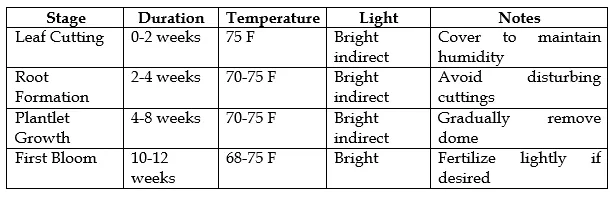
Table: Growth Timeline for Leaf Cuttings
Where to Buy Violet Seeds Online
For those interested in seeds, you can also buy violet seeds online at Nadeau African Violet Seeds. We provide fresh seeds with detailed instructions, so even beginners can achieve great results. You can grow your favorite varieties from seed or propagate from existing leaves. Either way, the joy of watching your African violets grow is unmatched.
Final Tips for Successful Propagation
Start with a few leaves and keep your expectations realistic. Track your progress and adjust as needed. African violets reward consistent care and patience. Talking to your plants is optional but highly encouraged. I do it myself and I swear they bloom brighter when you compliment them.
After harvest, seeds from specific crosses are tested to determine their germination rates. Seeds are then stored in labeled vials under refrigeration at 40°F. Different varieties are handled separately to provide one of four seed options: Standard, Miniature, Trailer, and Fantasy. To ensure reliable germination, seeds usually show 60 to 85 percent germination rates, with Miniature seeds being on the lower end. Seeds with lower germination rates are considered “dropping seeds” and are sold accordingly.
Finally, each package of seeds contains at least 100 seeds. Since germination rates vary, the number of seeds is designed to provide enough viable seedlings for growers. When customers receive their seed packets, they are supplied with extra seeds to compensate for any that do not germinate. Our seeds generally begin germinating 13 to 15 days after sowing, and they should be planted carefully to avoid damaging them.
People Also Ask
1. Can African violets be propagated from a single leaf?
Yes, one healthy leaf can produce several plantlets.
2. How long does it take for leaf cuttings to root?
Rooting usually occurs in about 2 to 4 weeks.
3. Do I need special soil for vegetative propagation?
A light, well-draining mix works best.
4. Can I use tap water for leaf cuttings?
It is better to use filtered or room temperature water to avoid chlorine damage.
5. When will propagated plantlets bloom?
Most bloom in about 2 to 3 months depending on care and variety.
6. Can I propagate African violets year-round?
Yes, as long as temperature and light are consistent.