
How Lighting Affects African Violet Seed Sowing and Germination
How Lighting Affects African Violet Seed Sowing and Germination
Light is one of the biggest factors in how lighting affects African violet seed sowing and germination. I always make lighting an essential part of my African violet seed sowing directions because without the right type and amount, seeds often fail to sprout or produce weak seedlings. I’ve spent decades growing rare African violet varieties, and through both trial and careful study, I’ve learned exactly how lighting influences every stage of growth. In this post, I’ll share what I’ve discovered about the right light for germination, the role of timing, and simple tricks you can use to boost your success.
Why Lighting Matters for Germination
When people ask me why their seeds aren’t sprouting, the first thing I ask is, “How much light are they getting?” African violets don’t just need any light; they need the right type and amount. Poor lighting can slow germination, make seedlings weak, or even stop growth altogether. I’ve seen it happen more times than I can count, which is why light is a core part of my African violet seed sowing instructions.
My Experience with African Violet Seeds and Light
As Ronn Nadeau, holding a PhD in Organic Chemistry, I’ve worked with plant growth experiments for decades. My greenhouse is filled with rare African violet species that I’ve grown from seed, including hybrids that you can’t find anywhere else. Many of my customers follow my lighting advice and send me photos of strong, healthy seedlings. It’s proof that with the right light, even beginners can grow these plants beautifully.
The Science of Light and Seed Growth
Seeds respond to light through a process called photomorphogenesis, where light signals trigger plant development. African violet seeds are tiny, and they need exposure to light for successful germination—they are “light-sensitive germinators.” A 2022 horticultural study from the University of Florida found that seed germination rates for light-sensitive plants improved by up to 60% under controlled LED lighting compared to natural light alone.
Types of Lighting for Seed Starting
There are three main options:
· Natural Window Light – Works if you have a bright, indirect light location, but it can be inconsistent, especially in winter.
· Fluorescent Lights – Affordable and effective for beginners.
· LED Grow Lights – My top choice. They use less energy, produce little heat, and can be tailored to plant-friendly light spectrums.
Light Duration and Intensity: Getting the Balance Right
African violet seedlings do best with around 12–14 hours of light per day. Too little light, and they stretch out, becoming leggy. Too much light, and the leaves can bleach. I recommend placing lights about 12 inches above the soil surface during germination, then adjusting as seedlings grow.
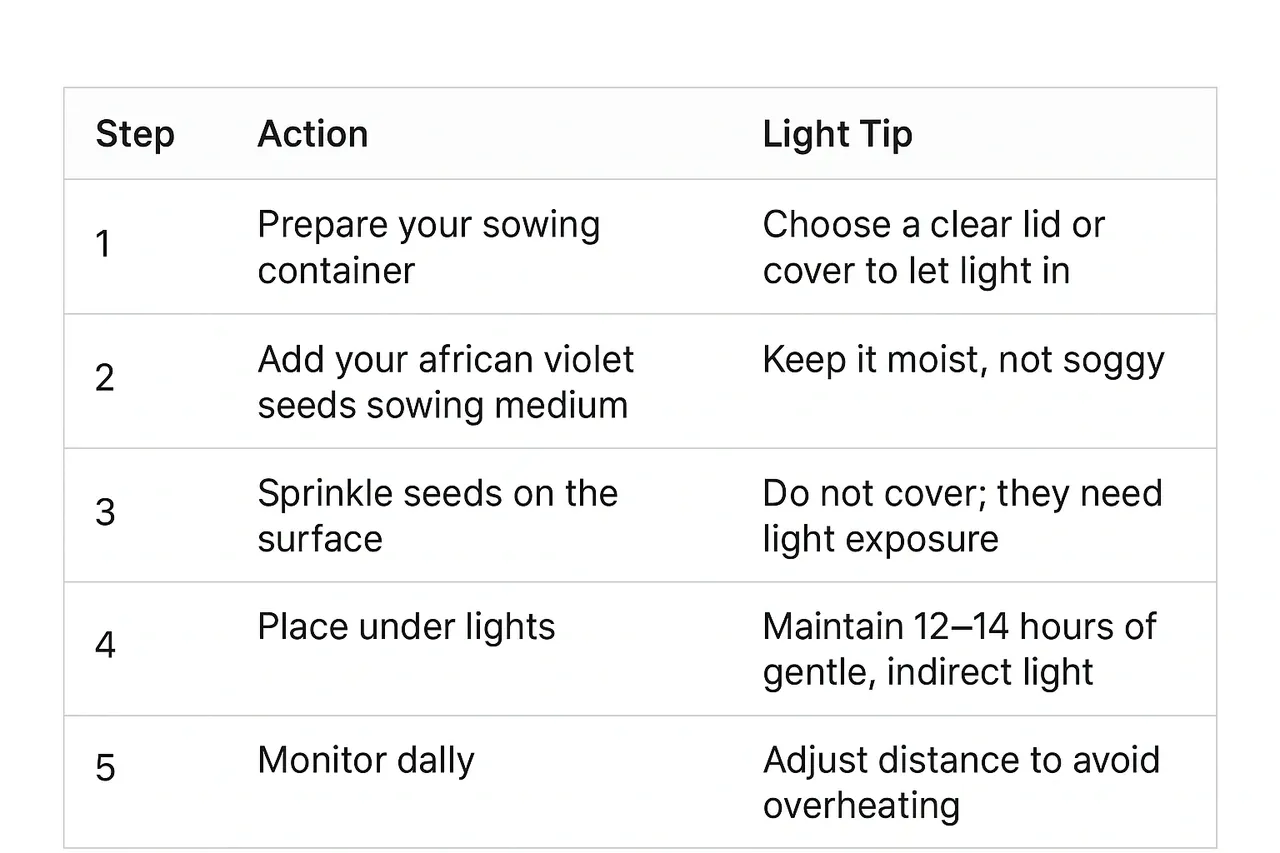
African Violet Seed Sowing Directions with Light Tips
Here’s the simplified version I give my customers:
Choosing the Right African Violet Seeds Sowing Medium
I always suggest a fine-textured, sterile African violet seeds sowing medium that drains well but holds enough moisture for germination. My personal mix includes peat moss, vermiculite, and perlite in equal parts. This type of medium is light enough for delicate roots, prevents fungus problems, and allows even the tiniest seeds to establish quickly. Choosing the right medium is just as important as light because it creates the perfect environment for healthy seedling growth.
Troubleshooting Common Lighting Problems
· Leggy seedlings: Light is too weak or too far away. Move lights closer.
· Yellowing leaves: May be too much direct heat from lights. Increase distance.
· Slow germination: Check that lights are on long enough and that the medium isn’t drying out too quickly.
Final Thoughts from My Greenhouse
Lighting is not just a small detail—it’s one of the most important factors for African violet seed germination. Once you understand how to balance light quality, duration, and placement, you’ll see a huge difference in your results. I’ve helped growers around the world transform their seed-starting success, and you can do it too.
As stated by a source, the demand for African violets is rising, with standard types remaining the most popular. However, the introduction of new varieties is also helping to boost interest and sales. If you ever want seeds that come with clear instructions and personal advice, you know where to find me—at Nadeau African Violet Seeds.
People Also Ask
1. Do African violet seeds need light to germinate?
Yes, they are light-sensitive germinators, so they must be placed on the soil surface, not buried. This allows the seeds to receive the light signals needed to trigger germination. Covering them with soil can block these signals and significantly reduce sprouting rates.
2. What is the best type of light for African violet seeds?
LED grow lights work best for consistent results year-round. They provide the right spectrum for seed germination while using minimal energy. Plus, they produce very little heat, so there’s less risk of damaging delicate seedlings.
3. How many hours of light do African violet seedlings need?
They typically require 12–14 hours per day. Consistent light each day allows seedlings to grow sturdy stems and lush, healthy leaves. Shorter periods can slow growth, while longer periods may cause stress to the plants.
4. Can I grow African violet seeds in a window?
Yes, but make sure the light is bright and indirect, and adjust for seasonal changes. Direct sunlight can scorch tender seedlings, especially in summer. In winter, extra lighting might be necessary to keep plants growing well.
5. Why are my African violet seedlings leggy?
Usually, it’s because the light source is too far away or too weak. Moving the light closer or upgrading to a stronger fixture can correct the problem. Proper lighting distance encourages compact, sturdy growth instead of thin, stretched stems.
6. What color spectrum is best for African violet seed growth?
A balanced mix of cool (blue) and warm (red) light encourages healthy growth and flowering later. Blue light supports strong leaf development, while red light promotes budding and blooming. Using both ensures your African violets thrive from seedling to full bloom.